

There are moments in life when we find ourselves asking difficult questions:
Why do I keep ending up in the same kinds of relationships?
Why do certain situations affect me so deeply?
Why do I feel responsible for everyone else’s needs?
Where did these beliefs about myself come from?
When we begin exploring these questions, we often discover that our lives are shaped by far more than our individual experiences. We are influenced by family stories, cultural messages, social expectations, life circumstances, and the identities we carry through the world.
Two powerful reflective tools used in counselling—genograms and Social GRACES—can help us develop a deeper understanding of ourselves. While they are often used in therapy and supervision, they can also be valuable tools for personal reflection and growth.
Rather than focusing on what is “wrong” with us, these approaches invite us to become curious about our experiences, relationships, and sense of identity. They help us move from self-judgement towards self-understanding.
Understanding the Bigger Picture
Many women grow up carrying invisible expectations.
Perhaps you learned to be the peacemaker in your family. Maybe you became the responsible one, the caretaker, the achiever, or the person who never caused trouble.
Over time, these roles can become so familiar that we stop questioning them. We simply assume, “This is who I am.”
Yet often these patterns began long before we were aware of them.
This is where a genogram can be helpful.
What Is a Genogram?
A genogram is like a family tree, but it goes much deeper.
Instead of simply recording who is related to whom, a genogram explores:
- Family relationships
- Emotional connections
- Significant life events
- Family roles
- Patterns of communication
- Beliefs and values passed between generations
- Social and environmental influences
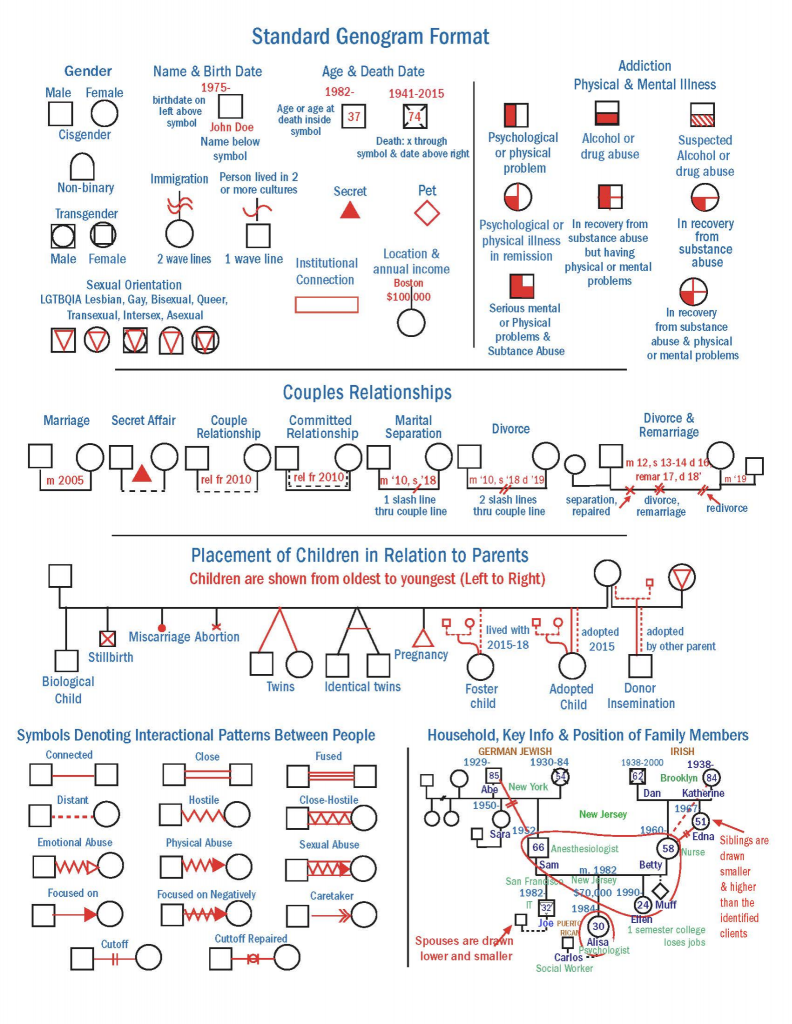
Monica McGoldrick – Own work standard genogram symbols 2023 CC BY-SA 4.0
Think of it as a map of your story.
As you begin creating one, you may notice recurring themes appearing across generations. Perhaps the women in your family were expected to put others first. Perhaps emotional expression was discouraged. Perhaps there were experiences of loss, migration, hardship, addiction, trauma, resilience, or strength that continue to influence family life today.
The purpose is not to blame previous generations.
Instead, it is about understanding the context from which you emerged.
A Gentle Exercise in Self-Reflection
If you would like to begin exploring your own genogram, start simply.
Take a piece of paper and place yourself in the centre.
Then begin adding:
- Parents and carers
- Grandparents if known
- Siblings
- Significant relationships
- Important life events
- Communities that have influenced you
As you look at what emerges, ask yourself:
- What roles existed within my family?
- What was encouraged?
- What was discouraged?
- How were emotions expressed?
- What messages did I receive about being a woman?
- What patterns seem to repeat?
Remember, there is no right or wrong way to do this.
The aim is not perfection but awareness.
Looking Beyond Family: The Social GRACES
While family relationships shape us, they are only part of our story.
We are also influenced by our identities and the social world around us.
The Social GRACES framework helps us explore this wider picture by encouraging reflection on aspects of identity such as:
- Gender
- Geography
- Race
- Religion
- Age
- Ability
- Appearance
- Class
- Culture
- Ethnicity
- Education
- Employment
- Sexuality
- Sexual orientation
- Spirituality
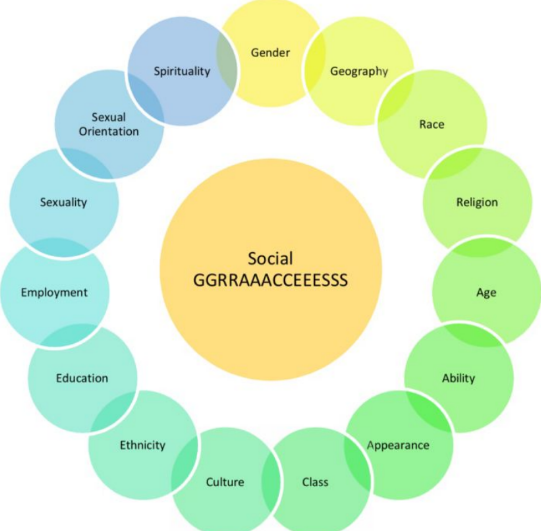
Image by Lisa Williams
Each of these experiences contributes to how we see ourselves and how the world responds to us.
For many women, some aspects of identity may feel highly visible, while others remain hidden or misunderstood.
The Stories We Carry
One of the most powerful aspects of the Social GRACES framework is that it encourages us to notice the stories attached to our identities.
For example:
- What messages did you receive about ageing?
- What beliefs were attached to your social class?
- How was education viewed within your family?
- What expectations existed around gender?
- Where did you feel you belonged?
- Where did you feel different?
Often, the beliefs we carry about ourselves are not entirely our own. They may have developed through family messages, cultural expectations, social experiences, or experiences of exclusion and belonging.
Bringing these influences into awareness can be incredibly freeing.
Moving from Self-Criticism to Self-Compassion
Trauma-informed practice reminds us that many behaviours make sense when we understand the context in which they developed.
Perhaps your perfectionism helped you feel safe.
Perhaps your people-pleasing protected important relationships.
Perhaps your independence developed because support was unavailable.
When we understand where these patterns come from, we can begin responding to ourselves with greater compassion.
Instead of asking:
“What’s wrong with me?”
We can begin asking:
“What happened to me?”
“What did I learn?”
“What was I trying to protect?”
These questions often open the door to healing.
Integrating Both Approaches
When genograms and Social GRACES are used together, they create a rich and meaningful picture of our lives.
The genogram helps us understand our relational history.
The Social GRACES framework helps us understand our social and cultural experiences.
Together, they invite us to explore:
- Family roles and expectations
- Identity and belonging
- Power and privilege
- Cultural influences
- Unspoken family rules
- Life transitions
- Experiences of being seen or unseen
- Patterns that continue to influence us today
Most importantly, they encourage us to remain curious rather than judgemental.
Questions for Your Own Reflection
You may wish to spend some time journalling on the following questions:
- What role did I play within my family?
- How does that role affect me now?
- What beliefs about myself did I learn growing up?
- Which aspects of my identity feel most important to me?
- Where have I felt accepted and valued?
- Where have I felt different or excluded?
- What family patterns would I like to continue?
- What patterns would I like to change?
- What parts of myself deserve greater understanding and compassion?
There is no need to answer everything at once.
Sometimes a single question can open the door to profound insight.
A Final Thought
Self-understanding is rarely about finding one definitive answer.
More often, it is a process of gently uncovering the many influences that have shaped who we are.
Both genograms and the Social GRACES framework remind us that our stories exist within relationships, families, communities, cultures, and wider social systems.
As we begin to understand those influences, we often discover something important:
Many of the things we have criticised ourselves for are actually understandable responses to our experiences.
And from that place of understanding, change becomes possible.
Not through force or self-judgement, but through curiosity, compassion, and a deeper connection with ourselves.
Your story matters. Taking the time to map it, explore it, and understand it is not self-indulgent—it is an act of self-care, self-awareness, and healing.
Sources:
Williams, L. (2025). Mapping the Self: Part 1 – An Introduction to Genograms [lecture]. Counsellor CPD. Counselling Tutor. [19/06/26].
Williams, L. (2026). Mapping the Self: Part 2 – Social GRACES [lecture]. Counsellor CPD. Counselling Tutor. [23/06/26].
Williams, L. (2026). Mapping the Self: Part 3 – Integrating Genograms & Social GRACES [lecture]. Counsellor CPD. Counselling Tutor. [23/06/26].